The following list of attributes reflects the expectations placed on Product Managers at many large organizations. These attributes are centered on a mid-level Product Manager (L5) but scale +/- 1 level pretty easily.
You can find a table version here which can be very useful for self-assessments and career planning.
I spent about 7 years working at Verily, which is a sister company to Google and they leveraged most of their internal processes when it started. At Verily we broke the PM job ladder into a set of categories based on those used by Google back in ~2016. I spent time on the PM Steering Committee with a focus on evolving our ladder and building community. I extended our ladder to include Entrepreneurship in 2019 to reflect the demands on PMs driven by startup nature of our business.
I organized the categories in this stack to highlight the distinct layers centered around leadership with culture and communication as the 2 cornerstones.
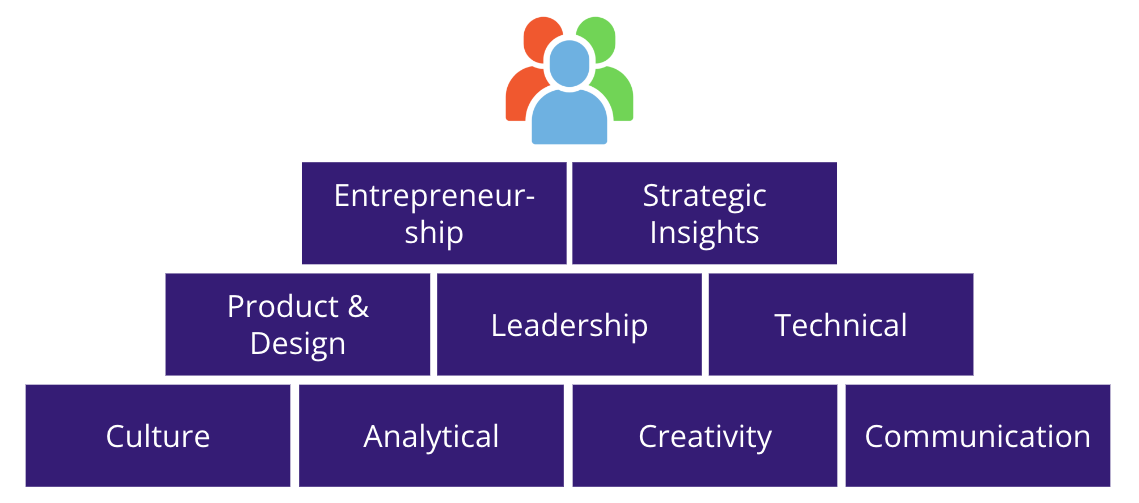
Beyond attributes, it’s important to guide your actions by clear principles such as those laid out by Brandon Chu in The First Principles of Product Management.
Attributes
- Entrepreneurship
- Strategic Insights
- Product & Design Fundamentals
- Leadership
- Analytical
- Communication
- Creativity
- Culture
General product references
- Behind Every Great Product, Marty Cagan
- Your product isn’t the product, Dharmesh Shah
- What Seven Years at Airbnb Taught Me About Building a Business | by Lenny Rachitsky | Marker
- What exactly is a Product Manager, Martin Eriksson
- Top 1% PM, Ian McAllister
- Good Product Manager/Bad Product Manager | Andreessen Horowitz. Ben Horowitz and David Weiden. Written in 1997. Lots of great themes but even the authors say that it is dated at this point. PMs are not the CEO of their product — that’s a catchy but misleading metaphor that has led to a lot of dysfunction in PM land over the years.